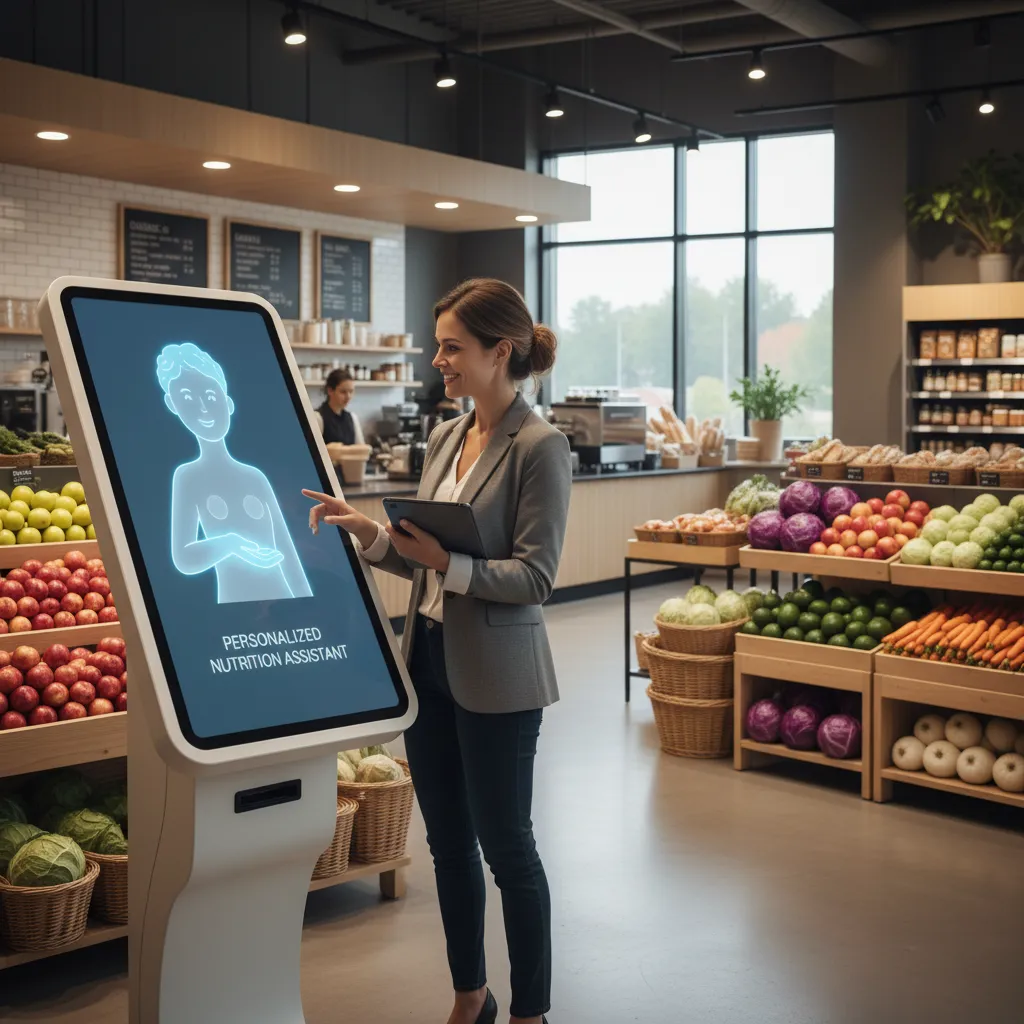
An AI chatbot for food and grocery ecommerce is not a simple support widget. It is a 24/7 aisle advisor — able to answer questions about allergens, product origin, storage instructions, and food pairings without ever putting a customer on hold at the moment they are about to place an order. If you want a broader look at how AI is transforming this sector, our guide on AI chatbot for food and grocery covers the full landscape of use cases in the food industry.
Online food retail carries requirements that most generic chatbots simply cannot meet. A visitor browsing a gourmet grocery store is not just comparing prices: they want to know whether the smoked salmon is certified sustainable, whether the truffle oil contains sulfites, and whether a Christmas hamper can be delivered before December 24. These questions have precise, documented, and often regulatory answers. They do not tolerate approximation.
This sector guide shows how a document-driven AI agent — powered by RAG technology — handles these specific demands. It is aimed at food ecommerce merchants: gourmet delis, food DTC brands, farm box subscriptions, online wine merchants, and organic delivery services. For a broader framework, our guide on ecommerce customer service automation covers the foundations before diving into this vertical. And if you sell in a different category, our ecommerce AI chatbot use cases by industry guide breaks down how each sector applies the same approach — the same subscription and repeat-purchase dynamics also drive an AI chatbot for pet shop and pet supplies ecommerce. If you operate in food service rather than pure ecommerce, our dedicated guide on chatbot for restaurant bookings and online orders covers that vertical specifically.
Table of Contents
- 1. Food Ecommerce in 2026: Growth, Seasonality, and Traceability
- 2. The Critical Pre-Purchase Questions in Food Retail
- 3. How an AI Chatbot Handles Product Traceability with RAG
- 4. Case Study: Personalized Advice for a Gourmet Grocery Basket
- 5. Seasonality and Product Launches: Managing Peaks and Limited Stock
- 6. Food Ecommerce Regulations: Consumer Information, Allergens, Alcohol
- 7. Food-Specific KPIs: Repeat Purchase Rate, AOV, NPS, Quality Returns
- 8. FAQ
1. Food Ecommerce in 2026: Growth, Seasonality, and Traceability
A structurally expanding market
Online food and grocery retail now accounts for over 10% of all ecommerce sales in the US and UK, and continues to grow year over year. Three parallel trends are driving this expansion: the rise of online grocery ordering, the growth of gourmet and specialty food stores, and the emergence of food DTC brands (brands born online) that bypass traditional distribution entirely.
Research published by Statista confirms that direct-to-consumer food sales in the US grew over 38% between 2022 and 2025. A crisis of trust in certain processed and industrial products has accelerated this shift: buyers want to know what they eat, where it comes from, and how to store it.
Stronger seasonality than fashion or electronics
Food is the ecommerce sector most constrained by seasonality. Black truffles run November through March. Foie gras peaks October through December. Gift hampers see 70% of orders land in the final two weeks of November. These spikes generate surges in customer contacts: questions about delivery deadlines, stock availability, box compositions, and refrigerated shipping options. Seasonal demand swings are sharp in food, but other verticals face their own winter and summer peaks — see how an AI chatbot for sports and outdoor ecommerce manages seasonal inventory.
Without automation, those peaks saturate support queues. With a well-documented AI chatbot, predictable questions are absorbed instantly — leaving your team to focus on complex cases: quality complaints, stock substitutions, and short-date lot management.
Traceability: from marketing claim to baseline expectation
In 2026, traceability is no longer a selling point — it is a minimum expectation. A IFIC Food and Health Survey found that 65% of online food buyers check product origin before completing their purchase. For specialty and gourmet stores, that figure climbs above 80%.
An AI chatbot trained on complete product data sheets — geographic origin, production method, best-by date, storage requirements — answers these questions without friction. It does not just satisfy curiosity: it removes the last barrier to purchase.
2. The Critical Pre-Purchase Questions in Food Retail
Food ecommerce generates a category of questions that other ecommerce verticals do not encounter: questions with health and safety implications. An incorrect answer about an allergen is not a customer service error — it is a potential public health risk. This is why documentary precision is non-negotiable here.
| Pre-purchase question | Category | Risk if unanswered | RAG source |
|---|---|---|---|
| "Does this product contain gluten?" | Mandatory allergen | Abandonment + health risk | Product sheet (FDA/EU INCO label data) |
| "What is the shelf life on arrival?" | Freshness / safety | Cart abandonment | Product sheet + logistics policy |
| "Where does this cheese come from?" | Origin / traceability | Loss of trust | Producer sheet / PDO/PGI data |
| "What wine pairs well with this foie gras?" | Advice / cross-sell | Reduced average order value | Food and wine pairing guide |
| "Do you ship with insulated packaging?" | Storage / logistics | Cart abandonment | Shipping page + logistics FAQ |
Why these questions cannot tolerate approximation
The FDA Food Allergen Labeling and Consumer Protection Act (FALCPA) requires that the nine major allergens — milk, eggs, fish, shellfish, tree nuts, peanuts, wheat, soybeans, and sesame — be clearly disclosed on food labels and product listings sold online. An incorrect chatbot response on allergen content exposes the merchant to legal liability. This is precisely why RAG technology is the right fit: the AI agent cites your official product documentation; it does not generate information on its own initiative.
A generic chatbot can hallucinate. A RAG chatbot trained on your official product sheets responds with exactly what your documentation states — no more, no less. If the answer is not in your knowledge base, it says so clearly and routes the customer to your support team.
3. How an AI Chatbot Handles Product Traceability with RAG
The principle: your documentation becomes the chatbot's intelligence
RAG (Retrieval-Augmented Generation) is the technology that differentiates a sector-specific AI chatbot from a generic bot. The principle is straightforward: you import your product sheets, storage guides, supplier certifications, and regulatory pages into the chatbot's knowledge base. These documents are indexed as semantic vectors. When a customer asks a question, the system retrieves the most relevant passage and formulates a response in natural language.
For a gourmet grocery store, this means every product sheet — origin, allergens, indicative best-by date, storage conditions — becomes a source that can be queried in real time. The chatbot does not "know" anything by default: it reads your own documents and reformulates them for the customer.
What to document for food ecommerce
The quality of responses depends directly on the richness of your knowledge base. For a food ecommerce business, here is what to index:
- Enriched product sheets: name, full ingredient list, all regulated allergens, geographic origin, production method (organic, Non-GMO, PDO, PGI, Certified Humane), indicative best-by date on arrival, nutritional values
- Storage guides: refrigeration temperature, how long after opening, freezing instructions where applicable
- Producer profiles: farm or producer name, region, farming practices, certifications — ideal for stores positioning on provenance and terroir
- Food and wine pairing guide (for wine merchants and gourmet delis with a wine selection)
- Food logistics FAQ: insulated packaging, zone-specific delivery windows, policy for damaged products on arrival
- Alcohol compliance information: age verification process, responsible consumption notices, state-specific shipping restrictions
Our article on AI product recommendations and cross-sell strategies shows how this same knowledge base can be used to increase average order value beyond basic informational advice.
Documentary traceability vs. real-time traceability
There are two levels to distinguish. Documentary traceability — what the product contains, where it comes from, how to store it — is immediately accessible via RAG. Real-time traceability — the specific lot number of your customer's order, the exact packing date — requires an API connection to your WMS or inventory management system. The first level is deployable in a matter of hours. The second requires a more advanced technical integration.
For the vast majority of gourmet stores and food DTC brands, documentary traceability is sufficient to remove 80% of pre-purchase objections.
4. Case Study: Personalized Advice for a Gourmet Grocery Basket
Scenario: gluten-intolerant guest, vegetarian diet, holiday gift
Here is a real exchange that a document-driven AI chatbot can handle on a gourmet grocery store. The customer — call her Sarah — arrives on the site with a specific need: to put together a holiday gift basket for a guest who is gluten-intolerant and vegetarian.
Without a chatbot, Sarah spends 15 minutes reading individual product pages, remains unsure about cross-contamination risks, and eventually sends an email to customer support. She may not hear back until the following day. She abandons her basket.
With a RAG chatbot trained on your product data:
- Sarah types: "I'm looking for a holiday gift basket, vegetarian and gluten-free, budget around $75"
- The chatbot queries the knowledge base: product sheets filtered by "gluten-free" and "vegetarian" within the price range
- It suggests three basket compositions, with product names, certifications, and prices
- Sarah asks: "Does the fig chutney contain sulfites?"
- The chatbot reads the allergen sheet: "According to our product sheet, the Maillard Farm fig chutney contains no sulfites and is made without added preservatives. Here is a link to the full product data sheet."
- Sarah adds the products and completes her order in under 8 minutes
What this scenario demonstrates
The AI agent did not invent the basket composition. It cross-referenced the customer's stated constraints with the information in your product sheets. The result is a personalized, precise, and traceable response — without involving a human agent, without delay, at any hour of the day or night.
This type of personalized guidance is one of the most profitable use cases for an AI chatbot in food retail: it converts hesitant visitors into confident buyers and increases average order value by surfacing relevant pairings. For a full overview of conversion strategies, our guide on increasing ecommerce conversion rates with AI covers the broader picture.
5. Seasonality and Product Launches: Managing Peaks and Limited Stock
Anticipating peak-season questions with an up-to-date knowledge base
Food seasonality generates predictable waves of customer questions. In November, customers ask about holiday delivery deadlines. In December, they want to know whether artisan products are still in stock. In summer, they worry about temperature-sensitive items during transit.
A well-configured chatbot anticipates these waves. The key is to update the knowledge base before each peak: add Christmas logistics information in October, upload seasonal product sheets as soon as items arrive, and post out-of-stock messages the moment a product sells out. The chatbot will broadcast this information from the first question — no real-time intervention needed from your team.
Managing limited stock and limited-edition products
Gourmet stores and wine merchants frequently work with products in limited quantities: rare vintages, truffle season harvests, single-farm aged cheeses. When stock runs out, questions flood in: "Is it still available?", "When will it be restocked?", "Is there an equivalent?"
Document these scenarios in your knowledge base: create an "out of stock" sheet for each strategic product reference, with a recommended alternative and a waitlist message where relevant. The chatbot handles the disappointment gracefully — it does not simply say "no," it offers a path forward.
Product launches: the chatbot as first advisor
When a new product launches — a new vintage, an exclusive artisan sauce, a limited-edition gift box — visitors ask questions that nobody has anticipated yet. A chatbot trained on the launch sheet responds from day one: ingredients, producer story, serving suggestions, complementary products.
This is particularly valuable for farm box subscriptions and weekly CSA-style services, where each delivery brings a new set of products that customers are encountering for the first time.
6. Food Ecommerce Regulations: Consumer Information, Allergens, and Alcohol
Allergen disclosure requirements in the US and UK
In the United States, the FDA's FALCPA mandates clear disclosure of nine major food allergens on product labels and online listings. The FASTER Act of 2021 added sesame as the ninth major allergen, effective January 2023. In the UK, the Food Standards Agency requires the 14 EU-inherited allergens to be prominently declared on food products sold online.
A chatbot trained on these product sheets strengthens compliance: not only is the information present on the product page, it is also accessible conversationally — which reduces the risk of a customer completing a purchase without seeing the allergen disclosure.
The 9 major allergens (US) to document
Under FALCPA and the FASTER Act, the nine major allergens requiring mandatory disclosure in the US are: milk, eggs, fish, Crustacean shellfish, tree nuts, peanuts, wheat, soybeans, and sesame. Every product sheet must explicitly state the presence or absence of these substances.
Import this information into your RAG knowledge base in a structured format. When a customer asks "Is this product peanut-free?", the chatbot answers from the official product sheet — not from a general approximation.
Online alcohol sales: compliance and age restrictions
Online wine merchants and gourmet stores selling spirits operate under a patchwork of state-level regulations in the US, and under the TTB (Alcohol and Tobacco Tax and Trade Bureau) labeling requirements at the federal level. Direct-to-consumer wine shipping is legal in most but not all US states, and age verification at delivery is mandatory.
Configure your chatbot to include the appropriate legal notices when discussing alcohol, and to avoid promoting consumption. On Heeya, these constraints are built into the agent's system instructions. The chatbot can handle legitimate wine advisory questions — pairings, vintages, storage — within this framework. Age verification itself is a function of your ecommerce platform, not the chatbot.
Food ecommerce and digital regulation
Beyond food-specific obligations, online merchants must also comply with data protection regulations (CCPA in California, GDPR for EU/UK customers) when collecting personal data through the chatbot. If your agent collects a visitor's name, email address, or dietary preferences, that data is subject to consent requirements. Document this processing in your privacy policy and ensure your chatbot integrates a compliant consent mechanism.
7. Food-Specific KPIs: Repeat Purchase Rate, AOV, NPS, and Quality Returns
Repeat purchase rate: the number-one KPI in food
In food retail, the most valuable customer is not the one who spends the most on their first order — it is the one who comes back. The repeat purchase rate is the priority KPI for measuring a chatbot's impact on your business.
A chatbot that helps a customer find the right product, answers an allergen question without friction, and handles a quality complaint with care contributes directly to retention. According to Bain & Company research, customers who had a satisfying first experience with a brand are 3 to 5 times more likely to reorder than the average. Instant, accurate support is one of the primary triggers of that satisfaction.
Average order value: the natural cross-sell effect in food
A food AI chatbot is a natural cross-sell lever. When a customer asks about a particular charcuterie board, recommending a suitable wine or a fig preserve alongside it is expert advice — not an intrusive upsell. When they choose an artisan cheese, suggesting a sourdough cracker or a truffle honey increases the basket without friction.
Document these pairings in your knowledge base: build a pairing guide and associate products with their natural companions. The chatbot will use this to make contextual recommendations at every interaction.
NPS and quality returns: turning a complaint into loyalty
Food retail is the sector where quality returns are the most emotionally charged. A product that arrives damaged, a best-by date that is too short on delivery, packaging that has failed during transit — these situations generate strong emotional reactions. The speed and quality of the response are decisive.
A chatbot configured to handle quality complaints can qualify the issue (nature of the problem, product reference, order number), offer an immediate resolution (refund, store credit, reshipment), and escalate to a human agent when necessary — passing along full context so the customer never has to repeat themselves.
Measure your NPS specifically for conversations that involved a quality complaint. A post-complaint NPS above 30 signals exemplary handling. Below 0, it is a warning sign on the quality of your escalation process.
Recommended KPI dashboard for food ecommerce
- 60-day repeat purchase rate: target above 35% for a positioned gourmet store
- Average order value with chatbot interaction vs. without: measuring the cross-sell effect
- Autonomous resolution rate on allergen and shelf-life questions: target above 80%
- Post-complaint NPS: target above 20
- Cart abandonment rate on product-detail questions: measure the reduction attributable to the chatbot
For other ecommerce verticals and their specific KPIs, see our guides on handling returns and refunds with an AI chatbot and on AI chatbot order and delivery tracking for ecommerce.
8. FAQ — AI Chatbot for Food & Gourmet Grocery Ecommerce
Can an AI chatbot answer allergen questions without risk of error? ↓
Yes — provided you use RAG technology and official product sheets as the source. A RAG chatbot does not generate information on its own initiative: it cites and reformulates your documentation. If the product sheet states "contains wheat," that is what the chatbot says. If the information is not in your knowledge base, it says so clearly and routes the customer to your support team. Accuracy depends directly on the completeness of your product sheets — that is an editorial responsibility, not a technology challenge.
How do you handle questions about shelf life and product freshness? ↓
Best-by dates on arrival can be documented as indicative information in your product sheet: "Fresh products are shipped with a minimum of X days remaining on the best-by date." This information, indexed in your RAG knowledge base, lets the chatbot answer this frequent question instantly. For real-time best-by data (exact lot number), an API integration with your WMS is required — an additional layer of complexity suited to higher-volume operations.
Can the chatbot suggest food and wine pairings and build basket recommendations? ↓
Absolutely. This is one of the most profitable use cases for gourmet stores and online wine merchants. Import a food and wine pairing guide into your knowledge base, associate each product with its recommended companions, and the chatbot will offer relevant suggestions in every conversation. This contextual advice increases average order value without commercial friction — the customer receives expert guidance, not a sales pitch.
How do you configure a chatbot for online alcohol sales to stay compliant? ↓
Configure your chatbot with a system prompt that includes the relevant legal constraints: do not encourage excessive consumption, include mandatory responsible drinking notices, and do not target minors. On Heeya, these instructions are embedded in the agent's system guidance. The chatbot can respond to legitimate wine advisory questions — pairings, vintages, storage recommendations — within this framework. Age verification at the point of sale is a function of your ecommerce platform, not the chatbot.
What does an AI chatbot cost for a gourmet grocery store? ↓
With Heeya, you can get started with a fully operational RAG chatbot on your product catalog for €0/month on the Free plan, €19/month (~$22) on Standard, or €99/month (~$113) on Premium. The real investment is editorial: prepare complete product sheets (allergens, origin, storage), a pairing guide, and a logistics FAQ. Budget 4 to 8 hours of initial documentation work to build a solid knowledge base covering 100 to 200 SKUs. After that, the main ongoing task is updating the knowledge base when your catalog changes.
Can the chatbot handle quality complaints — damaged product, short shelf life on arrival? ↓
The chatbot can qualify the complaint — nature of the issue, product reference, order number, photo if needed — and offer a resolution based on your returns policy (refund, store credit, reshipment). For decisions involving a significant commercial gesture or an unusual situation, it escalates to a human agent while transmitting full context. The goal is to absorb straightforward complaints and qualify complex cases for your team — not to replace human judgment entirely in sensitive situations.
Further Reading
- Ecommerce Customer Service Automation: The Complete Pillar Guide
- AI Product Recommendations: Cross-Sell and Upsell Strategies for Ecommerce
- Qualify Ecommerce Leads with an AI Chatbot in 2026
- Reduce Cart Abandonment with an AI Chatbot: Complete Guide
- Handle Returns and Refunds with an AI Chatbot
- How to Increase Your Ecommerce Conversion Rate with AI in 2026
- AI Chatbot Pricing for Ecommerce: Full Breakdown 2026
- Shopify AI Chatbot Integration Guide 2026
Deploy your food ecommerce chatbot in under an hour
Import your product sheets, configure allergen and logistics rules, and launch your AI agent on your gourmet store or farm box subscription. GDPR and CCPA compliant by design.
14-day free trial · No credit card required · Cancel anytime