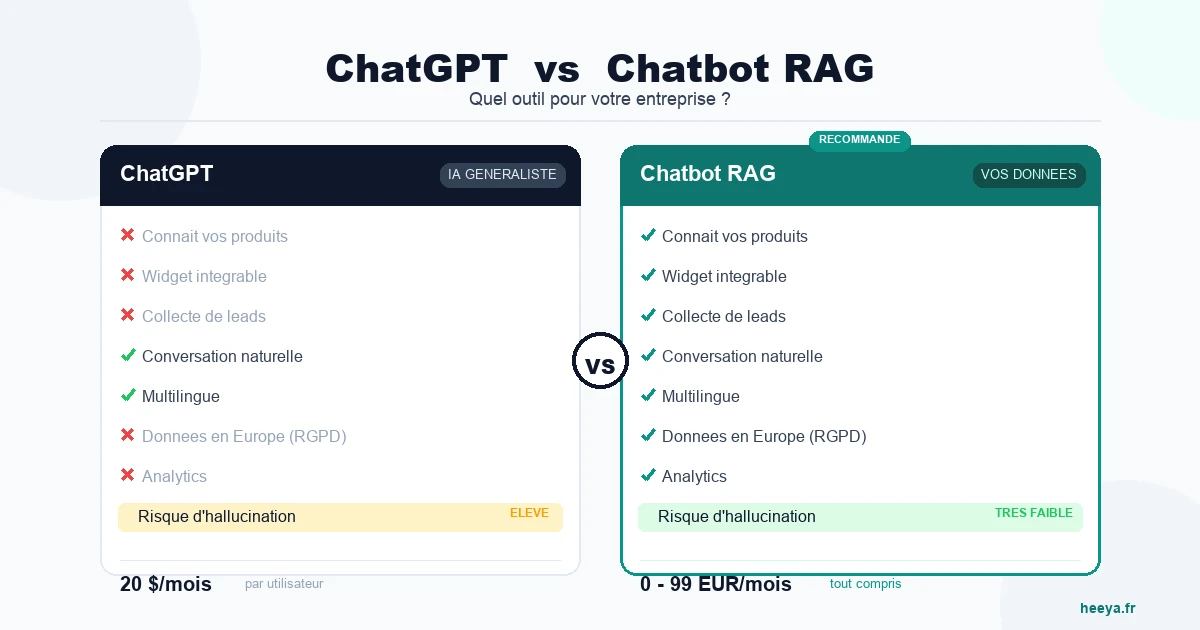
AI agent vs Custom GPT: you have tested a Custom GPT inside ChatGPT, the results looked promising — but something feels insufficient for a real business deployment. Your customers should not need an OpenAI account to talk to you. Your internal data should not transit through US-based servers. And your competitor should not have access to the same knowledge base as your virtual assistant.
Custom GPTs (OpenAI's personalised GPTs) are an appealing entry point into conversational AI. But for a serious enterprise deployment — especially in a client-facing context, with GDPR requirements and a genuine need for control — limitations surface quickly.
This honest comparison analyses both approaches on the criteria that actually matter: web integration, data privacy, GDPR compliance, knowledge base control, total cost, and the capabilities of a true dedicated RAG AI agent. The goal: help you decide whether your current Custom GPT is enough or whether it is time to move to the next level. If your specific need is embedding the assistant directly on your site, our guide on building a custom GPT for website deployment covers that narrower question in detail.
Table of Contents
- What Is a Custom GPT? How It Works and What It Actually Covers
- 5 Limitations of Custom GPTs for Businesses
- Dedicated RAG AI Agent: What Custom GPT Cannot Do
- Comparison Table: Custom GPT vs Dedicated RAG AI Agent
- GDPR and Data Privacy: The Breaking Point
- When to Stay on a Custom GPT vs When to Switch to a Dedicated RAG Agent
- FAQ
What Is a Custom GPT? How It Works and What It Actually Covers
A Custom GPT (or personalised GPT) is a conversational assistant you configure inside OpenAI's ChatGPT interface. You give it system instructions, you can upload files (PDF, Word, etc.) to serve as a knowledge base, and you can enable a handful of built-in tools (web search, image generation, Python interpreter).
The result is accessible via a shareable URL — provided your recipient has an active ChatGPT account. Since the GPT Store launched in early 2024, businesses can create internal GPTs restricted to their teams or public GPTs distributed on OpenAI's marketplace.
Technically, a Custom GPT does not perform RAG (Retrieval-Augmented Generation) in the strict sense: it injects your documents into the model's context window, which works well for moderate volumes but hits its limits as soon as your document base exceeds a few hundred pages or requires fine-grained semantic similarity search.
What Custom GPT Does Well
- Fast, no-code setup accessible to non-technical profiles.
- Immediate results for occasional internal use (teams already subscribed to ChatGPT).
- Ideal for quickly prototyping a topic-specific assistant before investing in a proper solution.
- Zero marginal cost if your team is already subscribed to ChatGPT Plus or Team.
What "Customised" Does Not Mean
The word "customised" is misleading. Your Custom GPT remains hosted on OpenAI's infrastructure, uses the same underlying model as every other GPT, and does not have a vector database dedicated to your data. Customisation is limited to the system prompt and document injection — not a technically isolated architecture for your business.
5 Limitations of Custom GPTs for Businesses
These limitations are not design flaws: they are inherent to what a Custom GPT actually is — a tool designed for individual ChatGPT users, extended to light professional use. The problem arises when you ask it to do what it was never built for.
1. Cannot Be Deployed on Your Website
This is the most immediate limitation for any client-facing use. A Custom GPT cannot be embedded as a widget on your site. Your visitors must leave your site, open ChatGPT, create or sign in to an OpenAI account, then access your GPT via its URL. This journey breaks the user experience and drastically reduces real-world adoption.
Technical workarounds exist via OpenAI's Assistants API, but they require significant custom development — at which point you have left the "no-code" scope of Custom GPT and entered a substantial technical project.
2. Your Data Goes Through OpenAI's Servers (USA)
By default, all conversations with a Custom GPT transit through OpenAI's servers located in the United States. OpenAI reserves the right to use this data to improve its models, unless you have subscribed to an Enterprise plan with an explicit opt-out. For Team and Plus subscriptions, this setting requires a manual action in account settings — something the vast majority of users never perform.
In practice, if your teams enter client information, contractual data, or sensitive commercial information into an unconfigured Custom GPT, you risk a GDPR breach and violations of your confidentiality obligations. This point is covered in the GDPR section of this article.
3. Unstructured and Limited Knowledge Base
Files uploaded to a Custom GPT are injected into the model's context window — not indexed in a vector database like Qdrant or Pinecone. This means:
- Effective size limit (a few hundred pages at most).
- No semantic similarity search: the model "reads" all documents at every conversation.
- No automatic updates: if your product catalogue changes, you must re-upload manually.
- No source traceability: difficult to know which part of the document underpinned a given answer.
4. Limited Memory and Context Between Sessions
A Custom GPT does not remember previous conversations unless you enable ChatGPT's memory feature — which remains experimental and is shared across all your GPTs. Each session starts from scratch for your user. In a client-facing context, this means a prospect returning a week later must re-explain everything — significant friction.
5. Total Dependency on the OpenAI Ecosystem
Your Custom GPT can only function as long as OpenAI allows it. Pricing changes, terms-of-service modifications, service outages, or decisions to restrict certain features: you have no leverage. In 2024–2025, OpenAI repeatedly modified its offerings (removal of GPT Store for individual developers, token limit changes) without adequate notice. For an SMB that has built its customer service on a Custom GPT, this is a real operational risk.
Dedicated RAG AI Agent: What Custom GPT Cannot Do
A dedicated RAG AI agent is a distinct architecture: you have a vector database specific to your business, an LLM accessible via API (OpenAI, Anthropic, Mistral, or others), and an interface deployable on your channels — website widget, iframe, API. Your data stays under your control.
In concrete terms, here is what a dedicated RAG agent makes possible that a Custom GPT does not:
Native Deployment on Your Website or Application
A customisable chat widget styled to your brand colours, embeddable on your site in a few lines of code, with no third-party account required from your visitors. The agent lives in your environment. Conversation data stays in your logging system — not in a third party's dashboard.
Vector Knowledge Base — Scalable and Source-Cited
Your documents (PDF, DOCX, PPTX, web pages) are split into chunks, converted into embeddings, and stored in a vector database (Qdrant, Pinecone, Weaviate). With every question, the semantic search engine retrieves the most relevant passages and injects them into the context — even if your knowledge base exceeds 10,000 pages. Updates are automatic: add a document and it is immediately available.
Choice of LLM and Hosting
You choose the model (GPT-4o, Claude 3.5, Gemini, Mistral) and can switch without rebuilding your deployment — if you lean toward Anthropic's models, our Claude AI training guide covers how to get the most out of the assistant. Better still, you can opt for EU-based hosting: vector database in Europe, encrypted API keys, logs stored locally. Your model provider can be configured to not use your data for training — with an explicit DPA agreement in place.
Persistent Conversational Memory Per User
Conversation history can be stored server-side and re-injected at each new session. A returning customer is recognised: the agent knows what they asked last week, what answers were given, and where their query stands. That is the difference between an assistant who knows you and a form that greets you as a stranger every time.
Comparison Table: Custom GPT vs Dedicated RAG AI Agent
| Criterion | Custom GPT (OpenAI) | Dedicated RAG AI Agent (e.g. Heeya) |
|---|---|---|
| Website deployment | Not natively possible — redirects to ChatGPT | Embeddable widget, iframe, or API — no third-party account |
| End-user access | Requires an active ChatGPT account | Accessible without sign-up, directly on your site |
| Data hosting | OpenAI servers (USA) | Configurable — EU hosting available (GDPR) |
| Knowledge base | Context injection — size-limited, manual updates | Vector database — unlimited size, automatic updates |
| Conversation privacy | OpenAI may use your data (outside Enterprise) | Data under your control, configurable DPA |
| GDPR compliance | Partial — requires manual opt-out, DPA only on Enterprise | Native — EU data, configurable retention policy |
| Memory between sessions | Limited, experimental, shared across GPTs | Persistent history per user, configurable |
| LLM model choice | GPT-4o only (OpenAI) | GPT, Claude, Gemini, Mistral — interchangeable |
| Branding and UX | ChatGPT interface imposed | Customised to your colours, logo, and tone of voice |
| Analytics and logs | Limited access via ChatGPT (outside Enterprise) | Full dashboard — questions, volumes, satisfaction |
| Entry cost | Included in ChatGPT Plus ($20/month/user) | From a few tens of dollars/month (SaaS) or custom pricing |
| Vendor dependency | Total — OpenAI can modify or remove the service | Interchangeable model, exportable data |
GDPR and Data Privacy: The Breaking Point
The question of GDPR compliance is often what tips the decision. Here are the facts, without shortcuts.
The Reality of Custom GPT Data Handling
By default, conversations in ChatGPT (including with Custom GPTs) are stored on OpenAI's servers in the United States. OpenAI reserves the right to use them for model training, unless manually disabled by the user in account settings — something the vast majority of users never do. Team and Plus plans require this individual action for each team member.
For the Enterprise plan, OpenAI offers a Data Processing Agreement (DPA) and automatic opt-out from training. But this plan is priced for teams of at least 150 users, with a negotiated annual contract — out of reach for most SMBs. Moreover, even on Enterprise, data transits through US infrastructure, which raises the question of cross-border data transfer under GDPR (Articles 44 et seq.).
The EU AI Act Deadline and What It Means
From August 2, 2026, the full obligations of the EU AI Act apply to generative AI systems in contact with end users. Businesses deploying client-facing AI solutions must be able to document their processing chain, explain automated decisions, and demonstrate compliance. A Custom GPT deployed via a ChatGPT link does not allow you to produce this documentation — you do not control the underlying system.
What a Dedicated RAG Architecture Enables
With a RAG agent hosted in Europe (vector database in the EU, LLM via API with a signed DPA, logs stored locally), you control the entire processing chain. You can configure conversation data retention policies, anonymise exchanges after a defined period, produce a record of processing activities compliant with GDPR Article 30, and respond to a user's access or erasure request without depending on a third party.
For businesses handling customer data (e-commerce, healthcare, HR, legal, finance), this level of control is not a luxury: it is a legal obligation. Learn more in our guide on AI chatbot data security for enterprises or discover how to deploy a GDPR-compliant AI chatbot for your business.
When to Stay on a Custom GPT vs When to Switch to a Dedicated RAG Agent
The honest answer depends on your context, not on commercial bias.
Stay on a Custom GPT If...
- Your use is strictly internal, limited to a team already subscribed to ChatGPT.
- Your shared documents contain no personal data or commercially sensitive information.
- You are in a testing phase and do not yet have a stable use case ready to scale.
- Your budget is zero in the short term and you need a quick prototype to build internal buy-in.
Switch to a Dedicated RAG Agent If...
- You want to deploy an assistant on your website, accessible to customers or prospects without friction.
- Your knowledge base exceeds 200–300 pages or is updated frequently.
- You process personal data (customers, employees, prospects) within conversations.
- You operate in a regulated sector (healthcare, finance, legal, HR) with confidentiality obligations.
- You need consistent branding — your agent should look like your business, not ChatGPT.
- You need analytics on questions asked, uncovered topics, and satisfaction scores.
- You want to change LLM model without rebuilding your deployment.
- You already use a rule-based chatbot and want to understand the steps to migrate from a rule-based chatbot to AI.
The Real Total Cost: Do Not Compare Only Subscription Prices
The Custom GPT appears free if your team is already subscribed to ChatGPT. But the real cost includes: GDPR risk (fines of up to 4% of global turnover), the cost of friction for your customers (drop-off rates, lost leads), the cost of manually maintaining the knowledge base, and the opportunity cost of a tool your customers cannot use directly.
For a business with €10 million in annual revenue, a GDPR fine could reach €400,000 — several hundred times the annual cost of a dedicated RAG agent.
A dedicated RAG agent on a platform like Heeya starts at a few tens of dollars per month for a complete deployment on your site — less than one hour of administrative work per month. The real question is not the price of the tool, but the price of inaction.
FAQ — AI Agent vs Custom GPT
Can a Custom GPT be embedded on my website?
No, not natively. A Custom GPT does not have an embeddable widget. Your visitors must leave your site, open ChatGPT, and sign in with an OpenAI account to access it. Technical workarounds exist via OpenAI's Assistants API, but they require significant custom development — at which point you leave the no-code scope of Custom GPT. A dedicated RAG agent (such as Heeya) integrates natively via a configurable widget, with no third-party account required from the end user.
Are Custom GPTs GDPR compliant?
Partially, and only under specific conditions. By default, conversations with a Custom GPT transit through OpenAI's servers in the United States, and OpenAI may use them for model training unless manually disabled. A DPA (Data Processing Agreement) is only available with the Enterprise plan (150+ users, annual contract). For an SMB processing personal customer data via a Custom GPT, the risk of GDPR non-compliance is real — with fines of up to 4% of global annual turnover or 20 million euros.
What is the difference between a Custom GPT and a RAG chatbot?
A Custom GPT injects your documents into the GPT model's context window — this is not RAG in the technical sense. A true RAG chatbot (Retrieval-Augmented Generation) indexes your documents in a vector database, performs a semantic similarity search at every question, and injects only the relevant passages into the context. A RAG chatbot handles much larger knowledge bases, provides sourced and traceable answers, and maintains performance regardless of document volume.
Can a Custom GPT be used for online customer support?
Technically, no — not directly. Your customers would need an active ChatGPT account and would have to navigate to an external URL to interact with your Custom GPT. This is a major friction point incompatible with a professional client-facing deployment. Additionally, your customers would be sharing their personal information on a third-party platform (OpenAI), raising GDPR compliance concerns. For online customer support, a dedicated RAG agent with an embedded widget is the only viable approach.
How much does a RAG AI agent cost compared to a Custom GPT?
A Custom GPT is included in a ChatGPT Plus subscription ($20/month/user) or Team ($25/month/user). A dedicated RAG agent on a SaaS platform starts at a few tens of dollars per month for a complete deployment on your site. The marginal cost difference is therefore small. But the true comparison must factor in the cost of GDPR risk, the cost of friction for your customers, and the cost of intensive manual maintenance of the document base — all of which weigh heavily against a Custom GPT used in a professional context.
Can my Custom GPT remember previous conversations?
Not reliably. ChatGPT's memory feature is shared across all your GPTs, experimental, and depends on individual user settings. Each conversation generally starts from scratch. A dedicated RAG agent can maintain persistent conversational history per user, stored server-side — allowing the agent to recognise a returning customer and pick up where the conversation left off.
What is the GPT Store and is it useful for businesses?
The GPT Store is OpenAI's marketplace where creators can publish Custom GPTs accessible to all ChatGPT users. For businesses, its value is very limited: you have no control over who accesses your GPT, no data on your users, and monetisation remains marginal (most creators cap at $100–500/month). The GPT Store is more of a distribution channel for consumer-facing tools than a platform for serious B2B business solutions.
Further Reading
- ChatGPT vs Custom RAG Chatbot: Which Tool for Your Business? — A deep dive into the architectural differences between the two approaches.
- AI Agent vs Chatbot: Key Differences and How to Choose — The criteria for distinguishing a simple chatbot from a true autonomous AI agent.
- Agentic AI: Autonomous Agents in the Enterprise (2026) — The complete guide to agentic architectures, design patterns, and business use cases.
- Connect an AI Agent to Your Tools — Once you choose a dedicated agent, here is how to wire it into your CRM and business systems.
- MCP for Enterprise AI Agents — The open protocol that lets a dedicated agent connect to your tools in a standardized way.
- Deploy a RAG AI Chatbot on Your Site — Heeya Solutions — Configure your dedicated AI agent, embeddable in minutes, GDPR-compliant.
- Heeya Plans and Pricing — Plans tailored to the size and needs of your business.